


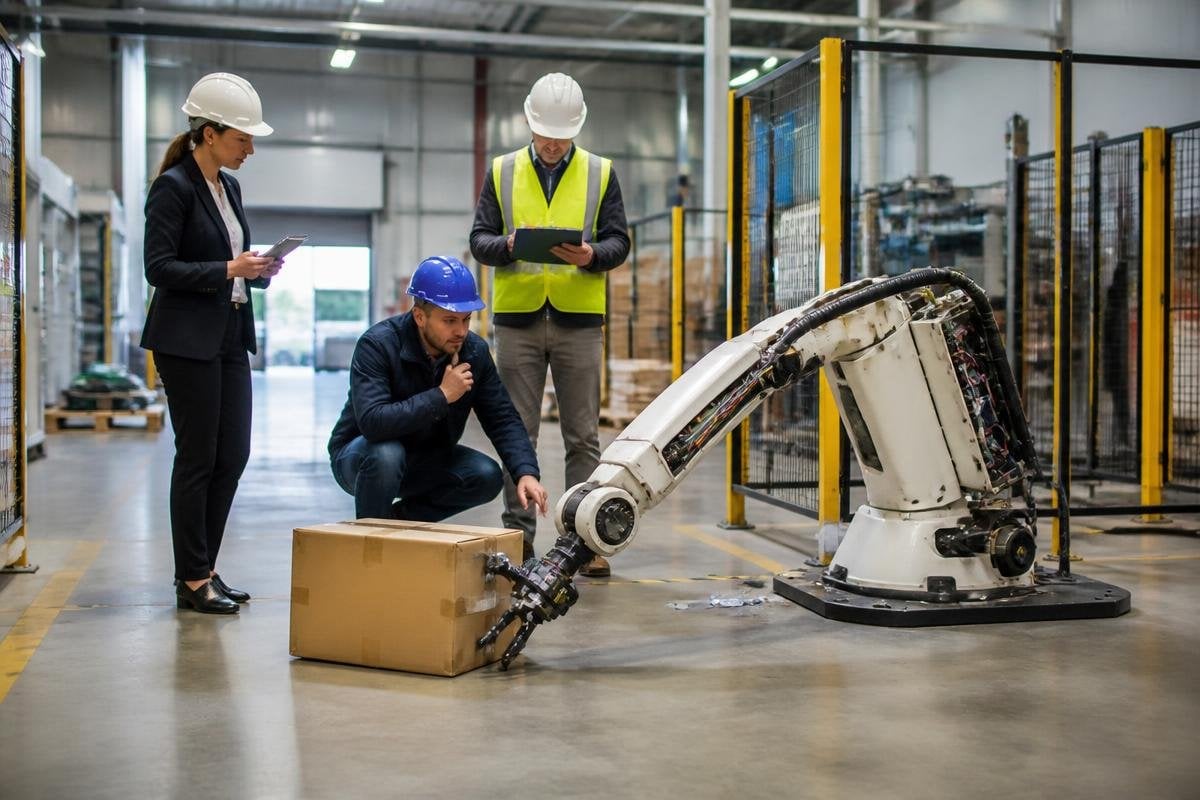
A robot accident can leave several parties facing the same question: who had the legal duty to prevent the harm? The answer usually starts with the failed control, then moves through the robot’s design, setup, use, maintenance, and supervision.
- The operator may be responsible for unsafe use or ignored warnings.
- The owner or company may answer for training, site safety, and maintenance.
- The maker or software supplier may face a product claim when a defect caused the harm.
The first question is what failed
A court or regulator will need a clear account of the event. It may examine the robot’s sensor logs, camera footage, emergency-stop records, maintenance history, and software version. Those records can show what the robot detected, what command it received, and why it kept moving.
That matters because “the robot caused it” describes the result, not the legal cause. The system may have moved after a sensor failed, after a worker entered a restricted area, or after someone changed a safety setting. Each fact points to a different party.
The owner should preserve the robot and its records after an accident. Turning it off can be sensible for safety, but changing settings, replacing parts, or deleting logs can make the event harder to examine.
When the operator or company may be responsible
An operator can face a claim if they ignored a warning, entered a marked work zone, or used the robot outside its instructions. The exact duty depends on the job, the training supplied, and the safety rules that applied at the site.
The company may also face responsibility for how the work was arranged. That can include staff training, access control, supervision, maintenance schedules, and the choice to run the robot near people.
In many legal systems, a company may answer for harm caused by an employee acting during assigned work, though the details vary by location.
A company that leases the robot may still carry duties that the maker does not. The contract can divide maintenance, updates, inspections, and operator training, but a contract does not always remove duties imposed by local safety law.
When the maker or software supplier may be responsible
A maker may face a product claim if a design defect, manufacturing defect, missing warning, or faulty safety function caused the accident. A software supplier may enter the case if its code sent an unsafe command or failed to react to sensor data that the system was built to use.
That claim still needs proof. The injured person may need to show that the robot had a safer design, that the defect existed when it left the maker’s control, and that the defect caused the injury. A court may also examine later changes made by the owner or a third-party integrator.
Liability can also turn on what happened after the robot left the factory. Robot24.com robotics coverage can put a named machine beside the way it was installed and used. That matters when several companies share the work, which is where integration can spread responsibility.
Integration can spread the responsibility
Many robots are assembled from parts supplied by different companies. The robot maker may provide the arm, an integrator may build the cell, and the site owner may connect it to conveyors, doors, cameras, or other equipment.
That chain matters when the accident happens at the boundary between systems. The arm may work as designed while the guarding system fails to stop it. The integrator may have chosen the wrong operating limits, or the owner may have removed a barrier to speed up work.
Criminal charges are a separate issue from a civil claim for money. They usually require proof of a serious breach of a legal duty, and the standard varies by jurisdiction. A regulator may also act without waiting for an injured person to file a lawsuit.
A practical evidence checklist
Use this list after people are safe and emergency services have been contacted:
- Preserve the original robot logs and controller files.
- Photograph the work area, guards, warning signs, floor marks, and control panels.
- Record the robot model, serial number, software version, and recent changes.
- Gather training sheets, risk assessments, maintenance records, and shift notes.
- Keep contracts showing who supplied, installed, updated, and serviced the system.
I’d start with the control that should have stopped the motion, then trace who owned that control on the day of the accident.
That approach gives an investigator a usable path through the facts. It also keeps the case from resting on the robot’s name alone, which is rarely enough to decide legal responsibility.
